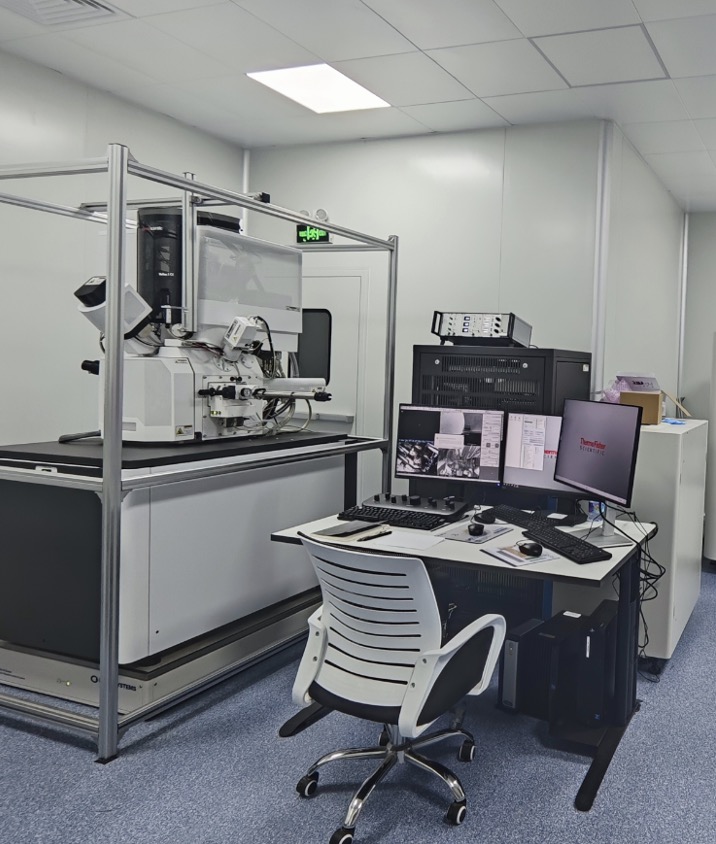
I. Instrument Applications
The Focused Ion Beam and Energy Dispersive Spectroscopy (FIB-EDS) system is primarily used for nanoscale processing of microscale regions in materials, cross-sectional slicing, TEM sample preparation, and three-dimensional reconstruction. It also enables qualitative and semi-quantitative elemental analysis, elemental mapping, and line scan analysis of micro-regions. It is suitable for microstructural observation, micro-area compositional analysis, and failure analysis of semiconductor devices, metals, ceramics, composites, and other samples.
II. Key Technical Specifications
1. Ion source: Liquid metal gallium (Ga) ion source;
2. Ion beam accelerating voltage: 2 kV, 30 kV;
3. Electron beam accelerating voltage: 500 V, 30 kV;
4. Secondary electron imaging resolution: ≤ 4 nm @ 30 kV;
5. Minimum ion beam spot size: nanoscale; capable of micro-region etching, deposition, a6. nd slicing for sample preparation;
7. Energy dispersive spectrometer: Silicon Drift Detector (SDD); detectable element range: Na to U;
8. Equipped with EDS point analysis, line scan, and elemental mapping capabilities;
9. Equipped with a sample vacuum transfer rod.
III. Appointment Instructions
1. Samples can be tested after submission or users may operate the instrument independently upon passing training.
2. Sample requirements: Samples must be conductive. Non-conductive samples should be coated with gold or carbon (available at the Testing Center). Sample dimensions and height must comply with the specimen stage travel limits. Samples must be non-magnetic, non-volatile, and free of corrosive components.
3. For sample preparation experiments (TEM lamella, cross-sectional cutting), the target region and processing dimensions must be discussed in advance.
4. Samples containing water, loose powders, or materials that outgas under high vacuum are strictly prohibited.
5. Instrument operation shall be performed preferentially by authorized personnel. New users must pass instrument training and assessment before independently booking and operating the instrument.
6. After use, clean the specimen stage, complete the instrument usage log, and promptly report any abnormalities or malfunctions to the instrument manager.