Barrel Gear Couplings
Rokee is a manufacturer of barrel gear couplings from china, we can provide non-standard custom barrel gear couplings based on parameters or drawings supplied by customers, with export support available.
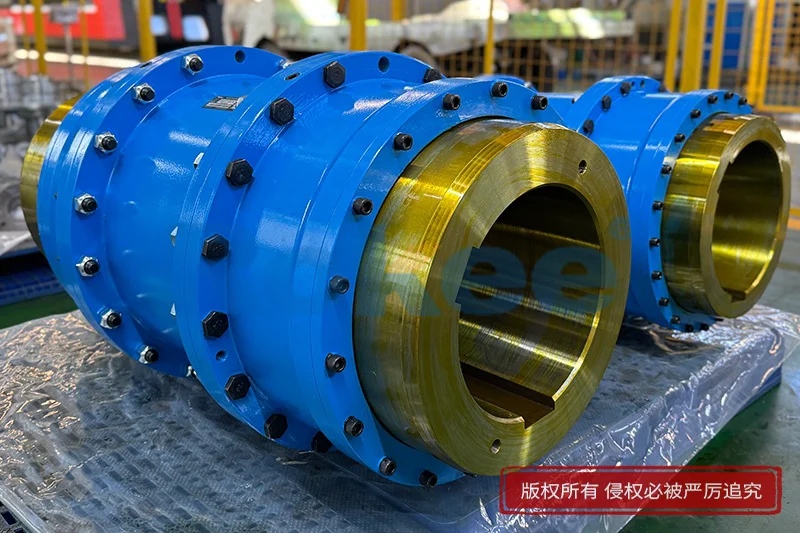
In the sophisticated and interconnected system of modern industrial mechanical transmission, the stability, efficiency, and durability of shaft connection components directly determine the overall operational quality of mechanical equipment. As a core rigid-flexible transmission component, barrel gear coupling has gradually become a preferred solution for heavy-duty and complex working condition transmission scenarios by virtue of its optimized curved tooth profile design, efficient torque transmission mechanism, and excellent misalignment compensation capability. Different from traditional straight-tooth gear couplings with rigid meshing limitations and elastic couplings with insufficient load-bearing capacity, barrel gear coupling perfectly balances high-precision power transmission and flexible adaptive adjustment, solving many common pain points in industrial shaft transmission such as installation deviation, operational vibration, alternating load impact and long-term wear failure. It is widely applied in heavy machinery, metallurgical industry, lifting equipment, wind power energy, marine engineering and other core industrial fields, and plays an irreplaceable role in ensuring the stable operation of mechanical systems, reducing equipment failure rates and extending the service life of transmission equipment.


The essential structural design of barrel gear coupling is the fundamental source of its superior transmission performance. The overall structure follows the mature combination mode of gear meshing transmission, and the core optimization lies in the innovative improvement of the external tooth profile of the gear hub. Traditional gear couplings adopt linear straight tooth structure, which will produce excessive local friction and stress concentration when facing shaft misalignment, resulting in rapid tooth surface wear and reduced transmission efficiency. In contrast, the external teeth of barrel gear coupling are processed into smooth arc barrel-shaped curved surfaces through precision machining technology. This unique curved tooth structure enables the gear meshing pair to form a larger contact area and more flexible meshing space during operation, and cooperates with the reasonable gap design between the inner gear sleeve and the outer gear hub to build a scientific flexible meshing system. The complete coupling assembly is mainly composed of two outer gear hubs, an inner gear sleeve, sealing components and lubrication structures. The outer gear hubs are respectively fixed on the driving shaft and the driven shaft, and the inner gear sleeve connects the two hubs through internal and external gear meshing, realizing synchronous rotation and torque transmission between the shafts. The integrated structural layout avoids redundant transmission links, ensures the rigidity of power transmission, and reserves sufficient deformation and adjustment space for shaft position deviation, realizing the organic integration of rigid transmission and flexible compensation.
The working mechanism of barrel gear coupling is based on the mechanical meshing principle of curved gear pairs and the flexible adaptive adjustment of shaft systems. In the actual operation of mechanical equipment, due to installation errors, equipment foundation settlement, thermal expansion and contraction of components, and long-term operational vibration, the connected driving shaft and driven shaft inevitably produce different degrees of misalignment, including radial deviation, axial deviation and angular deviation. These deviations are the main causes of transmission vibration, torque loss and component fatigue damage in mechanical systems. The barrel-shaped curved tooth design effectively solves the adaptation problem of multi-dimensional shaft misalignment. When angular deviation occurs between shafts, the arc tooth surface can automatically adjust the meshing angle to maintain uniform contact between gear pairs, avoid unilateral stress and local wear of straight teeth, and ensure continuous and stable torque transmission. For radial and axial deviations, the flexible gap between the inner and outer gears allows a certain range of relative displacement and sliding, which can effectively offset the shaft position offset generated during equipment operation without causing additional transmission resistance and mechanical stress. In the whole transmission process, the gear meshing state always maintains uniform and stable contact, the torque is transmitted evenly along the tooth surface, and the impact and vibration generated by shaft deviation are effectively buffered and absorbed, so as to realize low-noise, low-loss and high-stability power transmission.
Compared with other types of transmission couplings in the industry, barrel gear coupling has comprehensive and prominent performance advantages, which make it highly adaptable to harsh industrial working conditions. First of all, it has ultra-high torque transmission efficiency and heavy load bearing capacity. The curved tooth surface increases the effective contact area of gear meshing, disperses the unit stress of the tooth surface, enables the coupling to bear larger alternating load and impact load, and its overload resistance is significantly improved compared with ordinary straight-tooth gear couplings. This performance enables it to maintain stable transmission operation in heavy-duty equipment with frequent start-stop and variable load operation, and avoid tooth surface crushing, gear tooth fracture and other failure problems caused by instantaneous overload. Secondly, it has excellent multi-dimensional misalignment compensation ability. The optimized barrel tooth structure can adapt to radial, axial and angular composite deviations, with a larger compensation range than traditional couplings, and has lower requirements for installation accuracy of shaft systems, which greatly reduces the difficulty of equipment installation and debugging, and avoids additional assembly cost and time cost caused by excessive precision requirements.
In terms of operational stability and service life, barrel gear coupling also shows obvious advantages. The smooth arc tooth surface eliminates the stress concentration phenomenon of straight tooth meshing, reduces the friction coefficient in the meshing process, and effectively slows down the wear speed of the tooth surface during long-term continuous operation. Under the condition of reasonable lubrication and sealing, the wear loss of gear teeth is extremely low, and the long-term transmission accuracy can be maintained stably. In addition, the overall structural rigidity of the coupling is high, the deformation of components under load is small, and the synchronous rotation performance of the shaft system is excellent, which will not cause rotation speed difference and torque loss due to component deformation, ensuring the high-precision operation of mechanical transmission systems. The supporting sealing and lubrication structure further enhances its environmental adaptability. The closed sealing design can effectively isolate external dust, moisture, corrosive gas and other pollutants, prevent impurities from entering the gear meshing area to cause abrasive wear and corrosion, and maintain the cleanliness of the internal lubrication environment. The built-in lubrication system can continuously provide lubricating oil film for gear meshing pairs, reduce dry friction and mechanical loss, and further extend the service cycle of the coupling.
With the continuous upgrading of modern industrial manufacturing and the increasing demand for high-reliability mechanical transmission, barrel gear coupling has been widely used in various high-demand industrial scenarios, becoming a key basic component to support the stable operation of industrial equipment. In the heavy metallurgy industry, large-scale rolling mills, smelting equipment and forging machinery often operate under high load, high temperature and strong vibration conditions, with frequent load changes and harsh working environments. The heavy load resistance and vibration buffering performance of barrel gear coupling can fully adapt to the extreme working conditions of metallurgical equipment, ensure the continuous and stable operation of the transmission system, and reduce equipment shutdown failures caused by transmission component damage. In the field of lifting and transportation machinery, various cranes, hoists and conveyor equipment have high requirements for transmission safety and stability. The reliable torque transmission and overload protection performance of barrel gear coupling can effectively avoid transmission failure caused by instantaneous impact load during lifting and transportation, ensuring the operational safety of lifting equipment.
In the new energy industry, especially wind power generation equipment, the operating environment of wind turbines is complex and changeable, with long-term exposure to outdoor wind, rain, sand and temperature changes, and the transmission system needs to bear alternating wind load and rotational vibration for a long time. Barrel gear coupling has strong environmental adaptability and fatigue resistance, which can stably transmit power for wind turbine transmission systems, adapt to small deviations and vibration generated by long-term operation of fan shafts, and reduce the maintenance frequency of wind power equipment. In marine engineering and port machinery, equipment needs to face humid, saline and corrosive working environments, and the sealed and anti-corrosion structure of barrel gear coupling can effectively resist environmental corrosion, maintain stable transmission performance for a long time, and adapt to the high-reliability operation requirements of marine equipment. In addition, it also plays an important role in mining machinery, chemical equipment, power transmission equipment and precision industrial production lines, providing stable transmission support for various mechanical systems.
In industrial practical application, the scientific operation and standardized maintenance of barrel gear coupling are important guarantees to give full play to its performance and extend its service life. Although the coupling itself has excellent wear resistance and stability, long-term high-load operation will still cause normal loss of components, so regular daily inspection and maintenance are essential. In the daily operation process, it is necessary to regularly check the operating state of the coupling, observe whether there is abnormal vibration, noise and temperature rise during equipment operation, so as to judge whether the gear meshing state is normal and whether there is excessive wear or deviation overload. The sealing performance of the coupling should be inspected regularly to ensure that the sealing components are intact and no lubricating oil leakage or external impurity invasion occurs. Lubrication maintenance is the core link of coupling maintenance. It is necessary to select professional lubricating oil suitable for gear transmission according to the operating environment and load conditions, and replace and supplement lubricating oil regularly to ensure that the gear meshing surface always forms a complete lubricating oil film, reduce friction and wear, and avoid dry friction damage caused by insufficient lubrication.
At the same time, in the process of equipment operation, excessive overload and long-term continuous impact load should be avoided as far as possible. Although the barrel gear coupling has strong overload resistance, long-term overload operation will accelerate the fatigue aging of gear teeth, reduce the structural stability and service life of components. For equipment that has been operated for a long time, regular disassembly and inspection should be carried out to check the wear degree of gear tooth surface, the deformation state of structural components and the aging degree of sealing parts, and replace severely worn and aging components in a timely manner to ensure the overall matching accuracy and transmission performance of the coupling. Standardized installation is also the premise of stable operation of the coupling. The installation deviation of the shaft system must be strictly controlled during equipment assembly, and the installation error should be kept within the allowable compensation range of the coupling, so as to avoid excessive deviation leading to long-term abnormal stress of the coupling and accelerated failure of components.
With the continuous progress of industrial manufacturing technology and the gradual development of mechanical equipment towards high precision, high load and long life, the manufacturing process and performance of barrel gear coupling are also constantly optimized and upgraded. Modern precision machining technology and heat treatment process greatly improve the machining accuracy and structural strength of barrel gear teeth. The application of high-strength alloy materials further enhances the wear resistance, corrosion resistance and fatigue resistance of the coupling, enabling it to adapt to more extreme industrial working conditions. At the same time, with the development of intelligent industrial equipment, the structural design of barrel gear coupling is also developing towards miniaturization, high efficiency and intelligence. The optimized structural layout reduces the overall volume and weight of the coupling on the premise of ensuring load-bearing capacity, which is convenient for equipment integration and installation. The matching intelligent monitoring structure can realize real-time monitoring of coupling operating temperature, vibration state and wear degree, helping enterprises realize predictive maintenance of equipment, reduce unplanned shutdown losses, and improve the overall operational efficiency of industrial production lines.
In the whole field of mechanical power transmission, barrel gear coupling, as a high-performance rigid-flexible transmission component, solves many technical bottlenecks in traditional shaft connection transmission. Its unique barrel-shaped curved tooth meshing structure realizes the perfect combination of high-rigidity torque transmission and high-flexibility deviation compensation, and has irreplaceable application value in heavy-duty, high-vibration and complex environmental industrial scenarios. With the continuous development of industrial modernization, the requirements for the stability, reliability and service life of mechanical transmission systems are constantly improving, and barrel gear coupling will occupy a more important position in the field of industrial transmission. Through continuous optimization of material performance, structural design and processing technology, as well as standardized installation and maintenance management, barrel gear coupling can continuously exert its efficient and stable transmission advantages, provide solid basic support for the safe and efficient operation of modern industrial mechanical equipment, and promote the high-quality development of the mechanical manufacturing industry.
« Barrel Gear Couplings » Update Date: 2026/7/15
Contact
If you require custom machined couplings, please contact Rokee via the contact information below for inquiries.
Email: https://www.gshmdpq.com
 WeChat