Flexible Tyre Couplings
Rokee is a manufacturer of flexible tyre couplings from china, we can provide non-standard custom flexible tyre couplings based on parameters or drawings supplied by customers, with export support available.
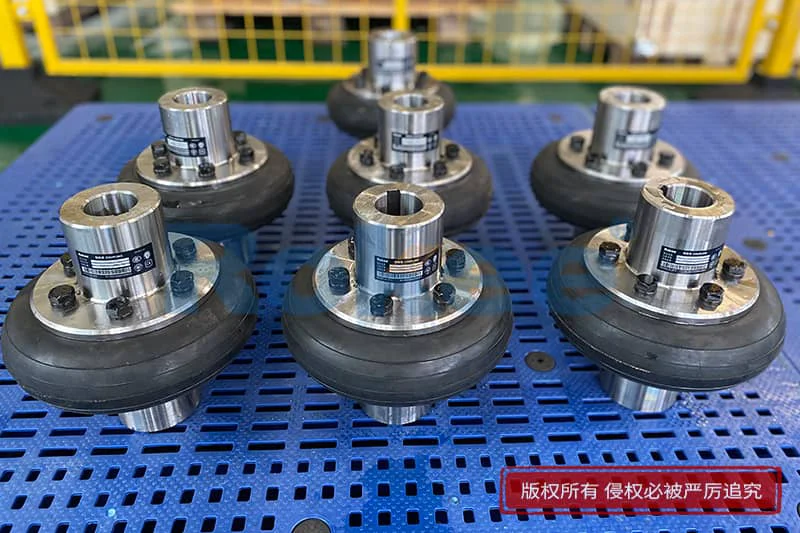
In the intricate ecosystem of mechanical power transmission, flexible tyre couplings stand out as a versatile and reliable connecting component, serving as a critical bridge between driving and driven equipment in diverse industrial machinery systems. As a core elastic transmission part, it integrates torque transmission, vibration attenuation, shock absorption and misalignment compensation into a single compact structure, solving many common operational pain points that plague traditional rigid couplings and ordinary flexible couplings in complex working environments. Unlike rigid connection structures that pursue absolute positional stability and rigid torque output, flexible tyre couplings rely on the unique elastic deformation characteristics of rubber tyre elastomers to achieve flexible power transmission, balancing the stability of power output and the adaptability of mechanical operation, which makes them widely applicable in medium and low-speed, high-torque, and variable-load mechanical transmission scenarios. With the continuous upgrading of industrial mechanical equipment and the increasing requirements for equipment operational stability and service life, the application value and market demand of flexible tyre couplings have been continuously improved, becoming an indispensable basic component in modern mechanical transmission systems.
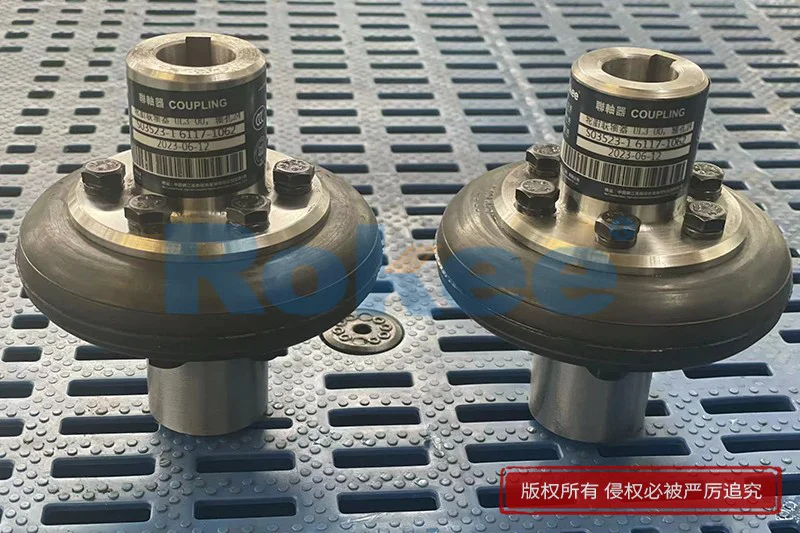

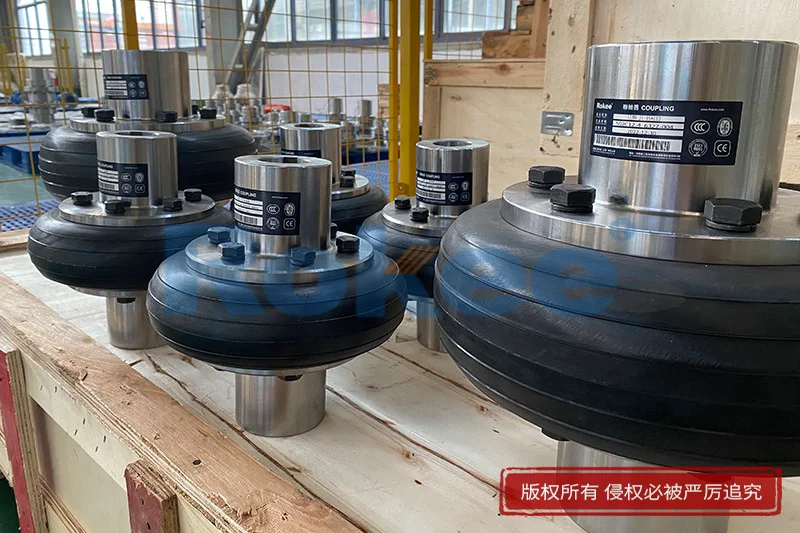
The basic structural composition of flexible tyre couplings is simple and scientific, without redundant accessories and complex assembly structures, which lays a solid foundation for its stable operation and convenient maintenance in long-term industrial use. The core functional part is an integrally formed tyre-shaped rubber elastic body, which is vulcanized and bonded with metal flanges on both sides to form an integrated transmission structure. The metal parts on both sides are connected to the driving shaft and driven shaft of the equipment respectively through reliable connection structures, realizing the fixed assembly of the coupling and the transmission of rotational torque. The rubber tyre elastomer is the key component that endows the coupling with flexible performance. Made of high-elastic rubber materials with excellent toughness and fatigue resistance, it can produce reversible elastic deformation under the action of torque, pressure and impact force, and can quickly recover its original shape after the external force disappears, ensuring long-term stable elastic performance without permanent deformation. Some optimized structural designs adopt split-type rubber tyre structures, which further simplify the later replacement process, avoiding the need to disassemble a large number of adjacent mechanical parts during maintenance, and greatly improving the convenience of equipment operation and maintenance. The overall structure abandons cumbersome transmission accessories such as springs and gears used in other flexible couplings, reducing structural failure points and effectively improving the overall operational reliability of the coupling.
The working principle of flexible tyre couplings is based on the elastic deformation and energy absorption characteristics of rubber elastomers, realizing efficient and stable flexible power transmission. In the normal operating state of the equipment, the rotational torque generated by the driving equipment is transmitted to the metal flange of the coupling, and the torque is further transferred to the rubber tyre elastomer through the metal structure. Driven by rotational force, the rubber tyre produces mild elastic shear and torsional deformation, and stably transmits the torque to the metal flange on the driven side, finally driving the driven shaft and supporting equipment to operate synchronously. In this entire transmission process, the elastic deformation of the rubber tyre is not only the basic condition for torque transmission, but also the core mechanism for realizing various protective functions. When the equipment encounters unstable load changes, sudden startup and shutdown, or external impact during operation, the rubber elastomer can absorb and buffer instantaneous impact energy through enhanced elastic deformation, avoiding rigid impact and torque mutation between the driving and driven shafts. At the same time, the elastic structure can automatically compensate for multiple types of shaft misalignment generated during equipment operation, including angular deviation, parallel radial deviation and axial displacement, eliminating additional mechanical stress and friction loss caused by shaft misalignment, and ensuring the continuity and stability of power transmission.
One of the most prominent performance advantages of flexible tyre couplings is their excellent vibration damping and shock absorption capacity, which far exceeds that of most traditional transmission couplings. In the actual operation of industrial equipment, mechanical vibration is an unavoidable problem caused by rotating component operation, load fluctuation and friction movement. Long-term continuous vibration will not only increase the operating noise of the equipment, but also cause fatigue wear of mechanical parts, loose connection structures, and even accelerate the aging and damage of core components, shortening the overall service life of the equipment. The high-elastic rubber tyre structure of flexible tyre couplings can effectively absorb high-frequency vibration and periodic vibration generated during equipment operation, convert mechanical vibration energy into tiny elastic deformation energy and dissipate it, significantly reducing the vibration amplitude of the entire transmission system. For sudden load impacts and instantaneous torque shocks caused by equipment startup, shutdown, load switching and abnormal working conditions, the rubber elastomer can rely on its good toughness to buffer impact force, avoid rigid torque impact directly acting on the shaft, bearing and other precision components, and effectively protect the core transmission parts of the equipment from impact damage. This superior vibration and shock resistance makes the coupling particularly suitable for equipment with frequent startup and shutdown, variable load operation and unstable working conditions.
Strong misalignment compensation capability is another core advantage of flexible tyre couplings, which greatly reduces the installation and operation accuracy requirements of mechanical transmission systems. In the process of equipment installation and assembly, it is difficult to achieve absolute coaxial alignment of the driving and driven shafts due to manual operation errors and assembly process limitations. In addition, after long-term operation of the equipment, factors such as foundation slight settlement, mechanical component wear, thermal expansion and contraction of parts will cause gradual deviation of the shaft position, resulting in different degrees of misalignment between the two shafts. For rigid couplings and ordinary flexible couplings with limited compensation capacity, slight shaft misalignment will generate additional bending stress and friction torque, leading to increased equipment operation load, accelerated component wear, and even equipment jitter and abnormal noise in severe cases, affecting normal production operation. Flexible tyre couplings, by virtue of the super elastic deformation space of the rubber tyre body, can adapt to angular, radial and axial misalignment simultaneously, and can automatically adjust and compensate during operation without affecting the stability of torque transmission. Even in the case of continuous slight changes in shaft position, the coupling can maintain a stable operating state, effectively avoiding equipment failure and shutdown maintenance caused by misalignment problems, and improving the continuous operation efficiency of mechanical equipment.
In terms of daily operation and maintenance, flexible tyre couplings have obvious economic and practical advantages, which greatly reduce the later operation and maintenance cost of mechanical equipment. Different from many transmission couplings that require regular lubrication, oil replacement and sealing detection, flexible tyre couplings adopt a fully sealed rubber elastic structure with no relative friction movement between internal transmission parts, so no lubrication maintenance is required in the whole service cycle. This completely eliminates the maintenance links such as grease filling and lubricating oil replacement, saves maintenance time and consumable costs, and also avoids equipment pollution and environmental pollution problems caused by lubricant leakage. The overall structure is simple and compact, with few wearing parts, and the rubber tyre elastomer has excellent wear resistance, aging resistance and environmental adaptability, which can maintain stable performance in long-term continuous operation. When individual parts are aging and damaged after long-term use, the split structural design allows workers to complete replacement operations quickly without moving or disassembling adjacent equipment such as motors and gearboxes, greatly shortening equipment shutdown time and reducing production loss caused by maintenance. In addition, the universal structural design enables the coupling to adapt to different shaft diameter specifications through matching connecting parts, reducing equipment inventory pressure and improving the versatility and practicability of parts.
Flexible tyre couplings also show excellent environmental adaptability and operational stability in complex industrial working conditions, and can maintain reliable working performance in various harsh operating environments. The modified rubber materials used in the tyre elastomer have good moisture resistance, oxidation resistance and medium corrosion resistance, and can resist the erosion of humid air, dust and common industrial trace corrosive media, avoiding performance degradation and structural damage caused by environmental factors. In high-temperature and low-temperature alternating working environments, the material can maintain stable elastic toughness, without hardening and brittleness in low-temperature environments or softening and deformation in high-temperature environments, ensuring the consistency of vibration damping and compensation performance in variable temperature environments. Meanwhile, the metal components of the coupling are treated with anti-corrosion and anti-rust surface processes, which can effectively resist surface oxidation and rust, prevent structural corrosion and connection failure, and further improve the overall durability of the coupling. Whether it is continuous operation in indoor fixed production equipment or long-term work in outdoor open and harsh environments, flexible tyre couplings can maintain stable transmission performance and long service life.
Relying on a series of superior performance characteristics, flexible tyre couplings are widely used in various industrial mechanical transmission scenarios, covering many fields of industrial production and mechanical manufacturing. In fluid transmission equipment such as water pumps and fans, the coupling can buffer the vibration and impact generated by fluid fluctuation and equipment rotation, ensure the stable operation of fluid transmission systems, and reduce pipeline vibration and noise. In power equipment such as compressors and generators, it can adapt to frequent load changes and startup and shutdown operations, protect precision power components from torque impact, and improve the operational stability and power supply quality of power equipment. In general industrial transmission equipment such as conveyors and mixing machinery, which have complex working conditions and unstable loads, the excellent misalignment compensation and shock absorption performance of the coupling can effectively solve the vibration and jitter problems of equipment during operation, reduce component wear, and extend the service life of the entire equipment. In addition, it also has important application value in light industry machinery, chemical machinery, building materials machinery and other fields, becoming a universal and high-performance transmission connecting part in the industrial field.
In the whole mechanical transmission system, the application of flexible tyre couplings plays a positive role in optimizing equipment operation performance, reducing operating costs and improving production efficiency. The flexible transmission mode effectively reduces the rigid impact and mechanical fatigue of the transmission system, reduces the failure rate of mechanical parts, and greatly extends the maintenance cycle and overall service life of the equipment. The excellent vibration damping effect reduces the operating noise and vibration amplitude of the equipment, improves the on-site operating environment, and meets the environmental protection and comfortable operation requirements of modern industrial production. The convenient installation and maintenance performance reduces the technical threshold and time cost of equipment maintenance, improves the operating efficiency of production equipment, and creates good economic benefits for industrial production. Compared with other types of flexible couplings, flexible tyre couplings have a more balanced comprehensive performance, with no obvious shortcomings in compensation capacity, vibration damping effect, maintenance convenience and environmental adaptability, and have higher cost performance and application universality in medium and low-speed conventional transmission scenarios.
With the continuous development of industrial mechanical technology and the continuous improvement of equipment precision and intelligence level, the performance optimization and application scope of flexible tyre couplings are also constantly expanding. Through the continuous optimization of rubber material formula and structural design, the new generation of flexible tyre couplings has higher elastic stability, stronger fatigue resistance and longer service life, and can adapt to higher torque transmission and more complex variable-load working conditions. The structural design is more lightweight and compact, which can meet the installation and use requirements of miniaturized and integrated modern mechanical equipment. At the same time, with the increasing attention to energy-saving and consumption reduction in industrial production, the low friction and high-efficiency transmission characteristics of flexible tyre couplings can effectively reduce the power loss of the transmission system, helping mechanical equipment achieve energy-saving operation, which is in line with the development trend of green and low-carbon industrial production.
In conclusion, flexible tyre couplings, with their unique elastic structure, excellent vibration damping and shock absorption performance, powerful misalignment compensation capacity, low maintenance cost and strong environmental adaptability, have become an indispensable and important component in modern mechanical power transmission systems. It solves many practical problems in the operation of traditional transmission structures, realizes efficient, stable and low-consumption flexible power transmission, and provides a reliable guarantee for the long-term stable operation of various industrial mechanical equipment. With the continuous progress of industrial manufacturing technology and the continuous expansion of industrial application scenarios, flexible tyre couplings will continue to exert their unique performance advantages, continuously expand their application fields, and play a more important role in promoting the stable operation and efficient upgrading of modern industrial mechanical systems.
« Flexible Tyre Couplings » Update Date: 2026/7/17
Contact
If you require custom machined couplings, please contact Rokee via the contact information below for inquiries.
Email: https://www.gshmdpq.com
 WeChat