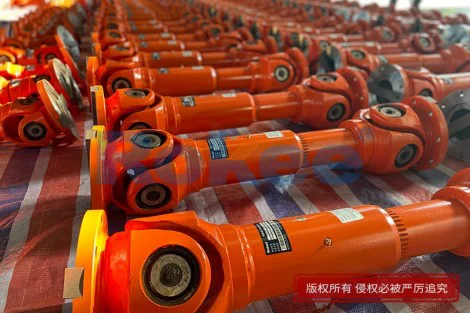
Universal Coupling Shaft
Rokee is a manufacturer of universal coupling shaft from china, we can provide non-standard custom universal coupling shaft based on parameters or drawings supplied by customers, with export support available.
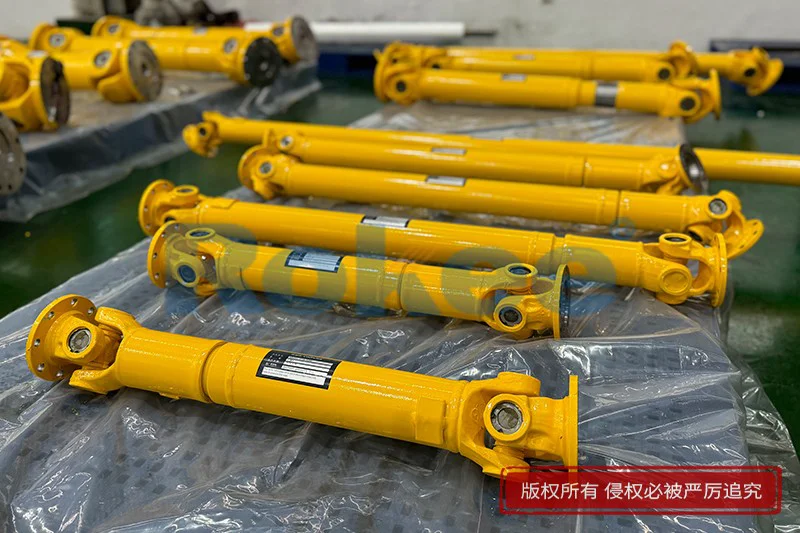
As a core flexible transmission component in modern mechanical power systems, the universal coupling shaft has become an indispensable connecting unit in various power transmission scenarios due to its unique spatial motion adaptability and reliable torque transmission performance. Unlike rigid coupling structures that strictly require coaxial alignment of connected shafts, this mechanical component can stably and continuously transmit rotational power and torque even when there are angular deviations, axial displacements and composite position offsets between the driving shaft and the driven shaft. Its distinctive structural design breaks through the limitations of traditional transmission parts, enabling mechanical equipment to maintain efficient operating states in complex and variable installation environments and dynamic working conditions, which makes it widely applied in mechanical transmission systems across multiple fields. The entire working process of the universal coupling shaft relies on pure mechanical kinematics principles, without the need for auxiliary power supply or intelligent control assistance, achieving passive and stable power transmission through the spatial hinge movement of internal components, and it has outstanding advantages in structural simplicity, operational reliability and environmental adaptability.


The basic working principle of the universal coupling shaft originates from the spatial compound motion characteristics of its internal cross hinge structure. The core transmission logic is to convert the fixed-axis rotary motion of the input driving end into the spatial swing composite motion of the intermediate cross shaft component, and then re-convert this irregular composite motion into stable fixed-axis rotary motion of the output driven end. This special motion conversion mechanism fundamentally solves the power transmission problem under non-coaxial working conditions. In the working state, the fork-shaped yoke structures fixed at both ends of the coupling shaft are respectively connected to the driving shaft and the driven shaft. When the driving end rotates, the driving yoke drives the cross shaft to perform synchronous rotary motion. At this time, the cross shaft will produce a small-amplitude swing displacement in the spatial dimension according to the angular deviation between the two shafts. This swing displacement can effectively compensate for the axis misalignment error, ensuring that the torque and rotational speed can be stably transmitted to the driven yoke and the driven shaft, avoiding the transmission interruption and mechanical jitter caused by shaft misalignment. Even when the included angle between the input shaft and the output shaft changes dynamically within a certain range during equipment operation, the cross hinge structure can adaptively adjust the motion posture to maintain the continuity and stability of power transmission.
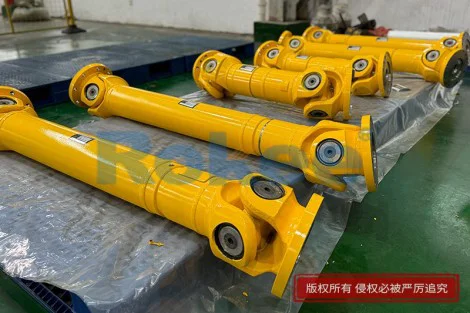
In terms of structural composition, the universal shaft coupling adopts a modular and compact design, and the main components include end connecting yokes, intermediate cross shaft assemblies, rolling bearing parts and telescopic connecting structures. Each component bears independent functional responsibilities and cooperates closely to complete the overall transmission work. The connecting yokes at both ends are the mounting and connecting parts of the coupling shaft and the equipment shaft. The fork-shaped structure can perfectly fit with the cross shaft, providing a stable stress foundation for torque transmission. The intermediate cross shaft is the core force-bearing and motion-compensating component. Its orthogonal spatial structure can bear multidirectional torque and bending force, and realize flexible angle adjustment. The rolling bearings installed at the matching positions of the cross shaft and the yoke can effectively reduce the friction resistance during relative motion, avoid dry friction and mechanical wear between metal components, and significantly improve transmission efficiency and service life. For long-distance transmission scenarios, the universal coupling shaft will be equipped with an axial telescopic spline structure. This structure can automatically compensate for the axial displacement caused by equipment vibration, thermal expansion and contraction, and installation errors in the working process, further optimizing the adaptability of the coupling shaft in complex working conditions.
One of the most prominent performance advantages of the universal coupling shaft is its excellent angular compensation capability. Compared with other flexible transmission couplings, it can adapt to a larger range of shaft angle deviations, and can still maintain efficient and stable power transmission under obvious angular offset conditions. This feature makes it uniquely applicable in mechanical systems where the relative position of the driving and driven shafts changes frequently or the installation space is limited. In traditional rigid transmission structures, slight shaft misalignment will cause additional alternating stress inside the equipment, leading to problems such as component vibration, noise, accelerated wear and even structural fatigue damage. The universal coupling shaft can absorb and offset most of the misalignment stress through its flexible hinge motion, effectively reducing the vibration and impact in the transmission process, smoothing the power output, and improving the overall operational stability of mechanical equipment. In addition, the compact structural layout of the universal coupling shaft enables it to occupy a small installation space while maintaining high load-bearing capacity, which is very suitable for compact mechanical equipment and integrated transmission systems with strict space constraints.
The transmission efficiency of the universal shaft coupling has always been a key advantage of its popularization and application. Thanks to the optimized structural design and low-friction matching mechanism, the power loss during the torque transmission process is extremely low, and it can maintain high-efficiency transmission states under both low-speed heavy-load and high-speed light-load working conditions. In the actual working process, the internal components move coordinately with precise motion relationships, and there is no redundant mechanical resistance or motion interference. The rolling friction formed by the bearing structure replaces the sliding friction of traditional flexible couplings, which not only reduces power consumption, but also avoids the heat accumulation and component aging problems caused by excessive friction. For mechanical equipment that needs long-term continuous operation, the high-efficiency transmission characteristic of the universal coupling shaft can effectively reduce the operating energy consumption, improve the overall working efficiency of the equipment, and reduce the frequency of failure shutdowns caused by transmission system problems.
Universal coupling shafts are widely used in various industrial transmission scenarios, covering mobile machinery, fixed industrial equipment, special power transmission systems and many other fields. In mobile mechanical equipment represented by engineering machinery and transportation machinery, the working posture of the equipment changes frequently, and the relative position of the power output end and the execution end is in a dynamic changing state for a long time. The universal coupling shaft can adapt to the real-time changes of shaft angle and displacement in the motion process, ensuring stable power output of walking, steering and execution mechanisms. In industrial production equipment such as automated production lines, transmission benches and processing machinery, there are inevitable installation errors and equipment operation vibrations during equipment assembly. The universal coupling shaft can compensate for various position deviations in the transmission system, ensure the synchronization accuracy of power transmission, and maintain the stable operation of automated production processes.
In addition, in heavy-duty transmission scenarios such as metallurgical equipment, mining machinery and agricultural machinery, the universal coupling shaft shows excellent heavy-load resistance and impact resistance. These working scenarios are often accompanied by harsh working conditions such as heavy load impact, dust pollution and variable working loads. The high-strength metal structure of the universal coupling shaft can bear large instantaneous torque and alternating load, and its sealed structural design can effectively isolate external dust, impurities and humid air, reducing the corrosion and wear of internal components. Different from precision couplings that are sensitive to the working environment, the universal coupling shaft has strong environmental adaptability, can maintain stable working performance in high-dust, high-humidity and variable-temperature working environments, and has extremely high working reliability in long-term heavy-duty operation.
Although the mechanical performance of universal coupling shafts is excellent, their operating state is still affected by installation accuracy, working load and daily maintenance. The installation alignment state directly determines the service life and transmission stability of the coupling shaft. Excessive artificial installation deviation will increase the operating load of the cross shaft and bearing components, leading to accelerated wear and early failure. In the actual installation process, it is necessary to control the initial offset angle and axial clearance within a reasonable range according to the structural characteristics of the equipment, so as to avoid additional stress caused by unreasonable installation. In terms of load use, although the coupling shaft has strong load-bearing capacity, long-term overload operation will cause fatigue deformation of internal stress components, resulting in increased transmission noise, jitter and even structural fracture. Therefore, it is necessary to match the appropriate type of universal coupling shaft according to the actual working load of the equipment to ensure that it works within the rated load range.
Daily maintenance and lubrication are key links to maintain the long-term stable performance of universal coupling shafts. The rotating and matching parts such as cross shafts and bearings need long-term lubrication protection to reduce friction and wear and prevent rust and corrosion. Regular lubrication maintenance can form a stable oil film on the surface of moving parts, buffer the mechanical impact during operation, reduce component wear, and effectively extend the service life of the coupling shaft. At the same time, it is necessary to regularly check the fastening state of the connecting parts and the sealing performance of the structure during daily use. Loose connecting bolts will cause transmission vibration and torque loss, and damaged sealing structures will lead to the entry of external impurities, inducing bearing jamming and component abrasion. Timely maintenance and minor repairs can avoid small faults evolving into large-scale equipment failures, reduce equipment maintenance costs, and improve the continuous operation capacity of mechanical systems.
With the continuous upgrading of modern mechanical equipment towards high precision, high efficiency and high durability, the structural design and performance of universal coupling shafts are also constantly optimized and iterated. Traditional universal coupling shafts are mostly designed with standard cross shaft structures, which have stable performance but limited adaptation to extreme working conditions. In recent years, with the progress of material technology and mechanical design technology, new high-strength, wear-resistant and corrosion-resistant materials have been gradually applied to the production of coupling shafts. The optimized structural design further reduces the motion friction resistance, improves the angular compensation range and load-bearing capacity, and enables the coupling shaft to adapt to more extreme high-speed, heavy-load and special environmental working conditions. At the same time, the integrated and lightweight design has become an important development direction of universal coupling shafts. On the premise of ensuring load-bearing performance, reducing the self-weight of components can effectively reduce the inertial resistance in the transmission process, improve the dynamic response speed of the mechanical system, and meet the high-precision and high-efficiency operation requirements of modern intelligent mechanical equipment.
In the entire field of mechanical power transmission, the universal coupling shaft occupies an irreplaceable core position. Its unique spatial motion compensation ability, simple and reliable mechanical structure, efficient transmission performance and strong environmental adaptability make it a key connecting component for bridging non-coaxial power transmission. Whether it is conventional industrial production equipment or special mobile machinery and heavy-duty working equipment, the universal coupling shaft can solve various difficult problems in flexible power transmission, ensure the stable transmission of torque and rotational motion, and provide a reliable guarantee for the normal operation of mechanical systems. With the continuous development of mechanical engineering technology, the performance of universal coupling shafts will be further improved, and their application fields will be continuously expanded, providing more diversified and high-efficiency solutions for modern mechanical power transmission systems, and continuously empowering the intelligent and high-efficiency development of the mechanical industry.
« Universal Coupling Shaft » Update Date: 2026/7/17
Contact
If you require custom machined couplings, please contact Rokee via the contact information below for inquiries.
Email: https://www.gshmdpq.com
 WeChat