Rubber Tyre Couplings
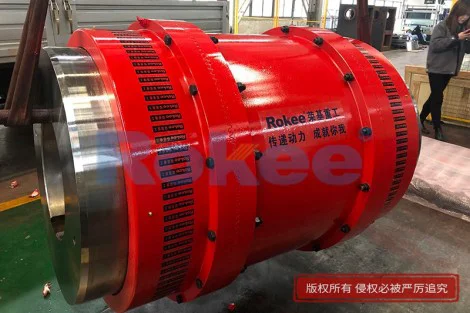
Rokee is a manufacturer of rubber tyre couplings from china, we can provide non-standard custom rubber tyre couplings based on parameters or drawings supplied by customers, with export support available.

In the complex and dynamic field of mechanical power transmission, flexible coupling components serve as indispensable connecting cores for various industrial equipment, undertaking the critical task of stably transmitting torque while buffering and isolating adverse mechanical factors generated during equipment operation. Among numerous flexible coupling types, rubber tyre coupling stands out with its unique structural design and excellent comprehensive performance, becoming a preferred transmission component for a wide range of mechanical systems that require vibration reduction, shock resistance and misalignment compensation. Unlike rigid couplings that pursue extreme transmission rigidity and single elastic couplings with limited adaptive capacity, rubber tyre coupling perfectly balances efficient power transmission and flexible mechanical adaptation, solving many common operational pain points of traditional transmission structures in industrial production, and has been widely applied in diverse mechanical scenarios from light-duty precision equipment to heavy-duty engineering machinery.


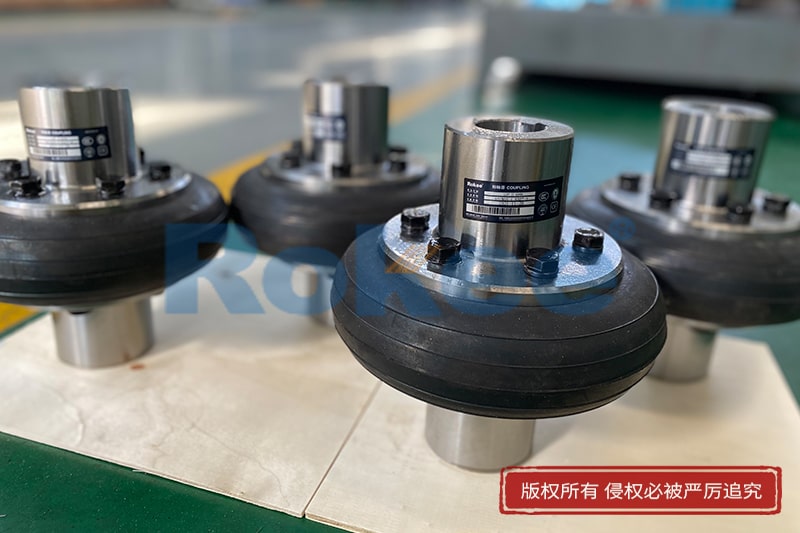
The basic structural composition of rubber tyre coupling is simple and scientific, without redundant accessory designs, which lays a solid foundation for its stable operation and convenient daily application. The entire component mainly consists of two symmetrical metal flange hubs and a middle tyre-shaped rubber elastic body, forming a three-in-one integrated transmission structure. The metal flange hubs, processed with high-precision manufacturing techniques, feature uniform structural strength and good rigidity, which can be stably fixed on the driving shaft and driven shaft of mechanical equipment respectively, ensuring reliable connection with the power transmission end and execution end. The core functional part is the vulcanized rubber elastic element with a special tyre-like curved structure. This elastic body is clamped and fixed between two metal flanges through high-strength fastening bolts, forming a closed and stable transmission whole. Different from flat or cylindrical elastic structures of ordinary couplings, the tyre-shaped curved structure endows the rubber part with larger elastic deformation space and more uniform stress distribution, avoiding local stress concentration that easily causes structural damage during long-term operation. Meanwhile, the integrated vulcanization process enhances the bonding tightness between the rubber body and the matching structure, effectively preventing relative displacement and friction loss between components during high-speed rotation, and greatly improving the overall structural stability and service life of the coupling.
The working principle of rubber tyre coupling is based on the elastic deformation characteristics of polymer rubber materials and the friction extrusion transmission mechanism between structural components, realizing organic integration of torque transmission, displacement compensation and dynamic load buffering. When the mechanical equipment starts to operate, the driving shaft drives the connected metal flange to perform synchronous rotational motion, and the rotational torque generated by the power device is uniformly transmitted to the intermediate rubber tyre elastomer through the fastening structure. Relying on the elastic shear and torsional deformation of the rubber material, the torque is further stably transmitted to the other metal flange and the connected driven shaft, thereby completing the continuous and efficient transmission of mechanical power. In this entire transmission process, the unique flexible structure of the rubber tyre body plays a core adaptive role. When installation deviation or operational displacement occurs between the driving shaft and the driven shaft, the rubber elastomer can produce micro elastic deformation in multiple directions including axial, radial and angular, automatically compensating for various misalignment errors between the two shafts. This real-time adaptive compensation capability avoids the additional mechanical stress and friction loss caused by rigid connection misalignment, effectively reducing the operating load of equipment bearings and transmission shafts. In addition, when the equipment is started, stopped or subjected to sudden load fluctuations, the rubber tyre structure can absorb and consume instantaneous impact energy through its own elastic deformation, buffer sharp torque fluctuations, and convert violent dynamic impact into gentle stable transmission force, so as to ensure the smooth and continuous operation of the entire mechanical transmission system.
Compared with gear couplings, sleeve couplings and other traditional transmission components, rubber tyre coupling has unparalleled comprehensive performance advantages in adaptive capacity, operational stability and maintenance cost control. First of all, it has ultra-high comprehensive misalignment compensation capability, which can simultaneously adapt to axial displacement, radial deviation and angular deflection generated during equipment installation and long-term operation. Its multi-directional flexible adaptation range is far wider than that of ordinary elastic couplings, and it can still maintain stable transmission performance even in mechanical systems with relatively large installation errors or slight structural deformation after long-term operation, greatly reducing the installation and debugging difficulty of mechanical equipment and the failure rate caused by shaft misalignment. Secondly, the rubber tyre coupling has excellent vibration damping and noise reduction effects. The high-elasticity rubber material can effectively isolate the high-frequency vibration generated by the power device during operation, prevent vibration from being transmitted along the shaft system to the executing equipment and the overall equipment frame, avoid resonance phenomenon of the mechanical system, and significantly reduce mechanical operation noise. This vibration isolation and noise reduction performance not only optimizes the operating environment of the equipment, but also effectively protects precision parts inside the mechanical system from vibration damage, improving the overall operating accuracy of the equipment.
In terms of operational reliability and economy, rubber tyre coupling also shows prominent advantages. The overall structure has no complex transmission accessories, no sliding friction parts and no gap transmission links, so there is no need for regular lubrication, oil replacement and other maintenance operations required by gear and chain transmission structures, which greatly reduces daily maintenance workload and long-term operating costs. The vulcanized rubber tyre body has good wear resistance, aging resistance and fatigue resistance, and can maintain stable elastic performance after tens of thousands of times of start-stop and load fluctuation cycles, with low failure rate and long service life. Moreover, the flexible transmission characteristic of the rubber tyre coupling can effectively protect the power source equipment and executing equipment. When the mechanical system encounters extreme overload and sudden impact load, the rubber elastomer can release excessive load stress through large elastic deformation, avoid rigid torque impact directly acting on motor, bearing and other precision and vulnerable parts, and play a good overload protection role for the entire mechanical system. In addition, the coupling has good low-temperature and high-temperature adaptive performance, and can maintain stable working elasticity in conventional industrial temperature environments, without hardening and failure of elastic function due to temperature changes, ensuring continuous and stable operation of equipment in different working conditions.
Relying on its superior comprehensive performance, rubber tyre coupling has been widely used in various industrial mechanical systems with complex working conditions and high stability requirements, covering multiple industrial production fields. In fluid power equipment such as various pumps and fans, the coupling is used to connect motors and rotating equipment. It can compensate for shaft displacement changes caused by thermal expansion and cold contraction of equipment during long-term operation, absorb high-frequency vibration generated by high-speed operation of fans and pumps, ensure stable output of fluid power, and avoid equipment operation failure and pipeline vibration damage caused by transmission instability. In power generation equipment systems, rubber tyre coupling can effectively isolate torsional vibration generated by power machinery operation, stabilize the torque transmission state of generator sets, prevent vibration interference from affecting power generation efficiency and power supply stability, and protect the precision power generation structure from dynamic load damage.
In mining, cement, chemical and other heavy-duty industrial fields, mechanical equipment often operates in harsh working environments with heavy load, frequent impact and severe vibration. The excellent shock absorption and impact resistance of rubber tyre coupling can well adapt to such harsh working conditions, buffer frequent load impact generated by heavy-duty machinery operation, reduce structural fatigue loss of equipment shaft system and transmission parts, and extend the service life of heavy-duty equipment. In marine propulsion systems, the coupling can compensate for installation errors of ship shaft systems and absorb irregular impact loads generated by propeller operation under complex water flow conditions, ensuring stable power output of ship power systems. In transportation and hoisting machinery equipment, it can buffer the instantaneous dynamic load generated by equipment start, stop and direction switching, avoid rigid impact damage of transmission structure, and improve the safety and stability of mechanical operation.
In terms of installation and daily application, rubber tyre coupling has strong operability and practicability. The standardized integrated structural design makes the installation process simple and efficient. Workers only need to fix the two metal flanges on the corresponding driving and driven shafts respectively, align the rubber tyre elastomer with the flange connecting holes, and fasten the bolts evenly to complete the assembly. The whole installation process does not require complex debugging tools and professional and complicated operation steps, which can effectively shorten the equipment assembly cycle and improve production and processing efficiency. In the daily operation process, the coupling has strong anti-fouling and anti-interference ability, and is not easy to be affected by dust, debris and conventional industrial corrosive media in the working environment. The external exposed structure is convenient for daily inspection and maintenance. Operators can directly observe the structural integrity of the rubber elastomer and the fastening state of bolts, timely find potential hidden dangers such as rubber aging, cracking and bolt loosening, and carry out targeted maintenance and replacement, avoiding equipment shutdown failures caused by minor component problems.
Although rubber tyre coupling has excellent comprehensive performance, its service life and operating effect are still affected by application environment and use mode in actual industrial applications. In long-term high-load and high-frequency impact working conditions, the rubber elastomer will gradually produce fatigue aging, and elastic performance will slowly decline with the extension of service time, which is a normal physical aging characteristic of polymer materials. In addition, long-term exposure to strong corrosive media, high-temperature baking or severe cold freezing environments will also accelerate the aging and damage of rubber materials and affect the transmission performance of the coupling. Therefore, in actual industrial matching use, it is necessary to select couplings with suitable rubber material formulas according to specific working conditions and environmental characteristics, and formulate reasonable regular inspection and replacement cycles. Timely replacement of aging and invalid elastic components can always maintain the optimal transmission state of the mechanical system and ensure the long-term stable operation of industrial equipment.
With the continuous upgrading and iteration of modern industrial machinery towards high efficiency, precision and intelligence, the requirements for the stability, adaptability and durability of power transmission components are constantly improving. As a mature and efficient flexible transmission component, rubber tyre coupling is also constantly optimized and upgraded in material formula and structural design. The upgraded high-performance synthetic rubber materials have better aging resistance, fatigue resistance and environmental adaptability, and can adapt to more extreme industrial working conditions. The optimized structural design further improves the uniformity of stress distribution, enhances the torque transmission capacity and structural stability of the coupling, and expands its application scope in high-power and high-precision mechanical systems. In the future industrial development process, rubber tyre coupling will rely on its unique flexible transmission advantages, excellent cost performance and reliable operational stability, and continue to play an irreplaceable core role in various mechanical power transmission systems, providing solid basic component support for the stable and efficient operation of modern industrial equipment.
« Rubber Tyre Couplings » Update Date: 2026/7/17
Contact
If you require custom machined couplings, please contact Rokee via the contact information below for inquiries.
Email: https://www.gshmdpq.com
 WeChat