Universal Joint Shaft Coupling Schematic Diagram
A universal joint shaft coupling stands as a core mechanical component dedicated to transmitting rotational torque and motion between two shafts that feature non-coaxial, angularly misaligned axes, serving as a critical linkage in countless mechanical drive systems across industrial, automotive, agricultural, and heavy machinery fields. When analyzing the schematic diagram of this coupling, one can gain a comprehensive understanding of its structural composition, operational mechanics, performance traits, and practical application boundaries, laying a solid foundation for rational selection, precise installation, and stable operation of such components. Unlike rigid couplings that demand strict coaxial alignment of connected shafts, the universal joint shaft coupling is engineered to accommodate intentional or unavoidable angular deviations between driving and driven shafts, ensuring uninterrupted power delivery even when the relative positions of the two shafts shift dynamically during operation, a capability that makes it irreplaceable in systems where shaft alignment cannot be maintained consistently.
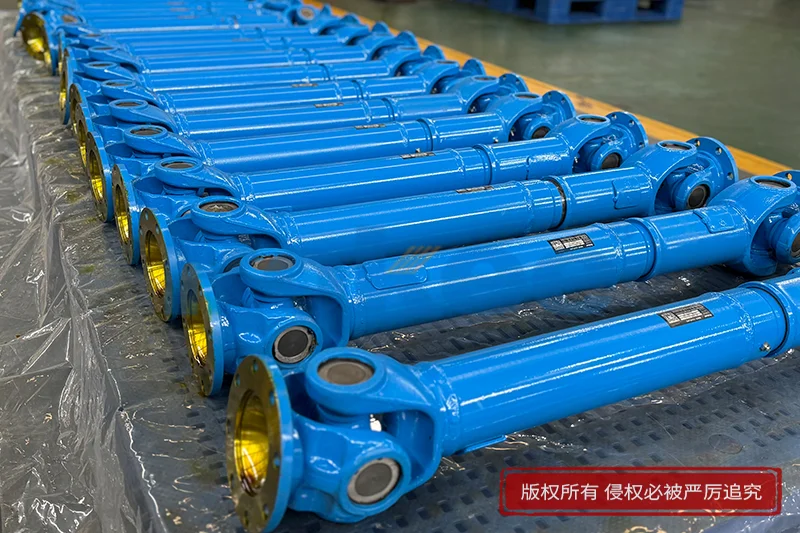
Starting with the structural details reflected in the schematic diagram, a standard universal joint shaft coupling is composed of several key integral parts, each with a clear functional role that contributes to the overall performance of the assembly. The most prominent elements in the schematic are the two yoke assemblies, also referred to as fork joints, which act as the connection hubs linking the coupling to the driving shaft and driven shaft respectively. Each yoke features a mounting end designed to attach to the corresponding shaft, whether via keyway connection, interference fit, or spline engagement, and a pivoting end with two opposing lugs that form the articulation point of the joint. At the heart of the coupling lies the cross-shaped spider, a central component with four perpendicular trunnions that fit precisely into the bearing seats within the yoke lugs. This cross spider is the pivotal part that enables the angular deflection of the joint, facilitating the transfer of torque between the two misaligned yokes. Surrounding each trunnion of the cross spider are precision bearings, typically needle roller bearings chosen for their high load-bearing capacity, compact size, and low friction characteristics; these bearings reduce rotational resistance between the cross spider and yokes, allowing smooth articulation while withstanding radial and axial loads generated during torque transmission. Additional auxiliary components visible in the schematic include sealing elements, such as dust caps and oil seals, which are positioned at the bearing joints to prevent the ingress of dust, moisture, and debris, while retaining lubricating grease inside the joint to minimize wear and extend service life. Some schematics may also depict retaining clips or locking plates that secure the bearings and cross spider in place, preventing component displacement under high-speed rotation or heavy load conditions.
The working principle of the universal joint shaft coupling, clearly illustrated by its schematic diagram, revolves around spatial linkage mechanics and flexible articulation, enabling torque transmission across angled shafts without disrupting rotational motion. When the driving shaft rotates, the torque is transferred to the adjacent yoke, which in turn drives the cross spider to rotate synchronously. As the cross spider turns, its perpendicular trunnions transmit the rotational force to the second yoke connected to the driven shaft, causing the driven shaft to rotate in tandem. The key advantage highlighted by the schematic is the ability of the cross spider to pivot freely within the yoke lugs, adjusting its angular orientation in real time to match the misalignment angle between the two shafts. This dynamic pivoting action ensures that rotational motion is converted and transferred smoothly even when the driving and driven shafts form a fixed or variable angle, eliminating the mechanical stress and binding that would occur with rigid connections. It is important to note from the schematic and corresponding mechanical analysis that a single universal joint exhibits non-constant velocity transmission characteristics; when the input shaft rotates at a uniform speed, the output shaft experiences slight fluctuations in rotational speed due to the angular deflection, with the speed variation amplitude directly related to the misalignment angle between the shafts. To mitigate this speed fluctuation and achieve constant velocity transmission, double universal joint configurations are commonly employed, as shown in more complex schematics, where two single joints are connected via an intermediate shaft and phased at 90 degrees to offset the velocity variations, resulting in consistent rotational speed between input and output shafts.
Delving deeper into the schematic diagram reveals the diverse performance parameters and adaptability of the universal joint shaft coupling, which determine its suitability for different operating environments and mechanical systems. One of the primary performance metrics is the allowable angular misalignment, which refers to the maximum angle between the driving and driven shafts that the coupling can accommodate while maintaining efficient torque transmission; standard designs typically support angular offsets ranging from a few degrees to over forty degrees, depending on the structural size and application requirements. The schematic also reflects the torque transmission capacity of the coupling, with larger cross-sectional dimensions of the cross spider and yokes corresponding to higher load-bearing capabilities, making them suitable for heavy-duty machinery such as mining equipment, rolling mills, and marine propulsion systems, while smaller, compact designs are tailored for light-duty applications like precision instruments, textile machinery, and small automotive components. Another critical trait showcased is axial flexibility, as many universal joint shaft couplings feature a telescopic design integrated into the intermediate shaft or yoke assemblies, allowing for minor axial displacement between the shafts to compensate for thermal expansion, installation tolerances, or dynamic movement during operation. Additionally, the schematic highlights the directional versatility of the coupling, as it can accommodate angular misalignment in multiple planes, not just a single vertical or horizontal plane, a feature that sets it apart from other flexible couplings and expands its application scope in complex mechanical drive systems.
The schematic diagram also serves as a visual guide to distinguish between different types of universal joint shaft couplings, each engineered to address specific operational needs and performance demands. The most common type depicted is the cross-type universal joint coupling, also known as the Cardan joint, which features the classic yoke and cross spider structure and is widely used for its simple design, ease of manufacturing, and cost-effective performance. This type is dominant in general industrial machinery, automotive drive shafts, and agricultural equipment, where moderate angular misalignment and reliable torque transmission are required. For applications demanding constant velocity transmission and smoother operation, constant velocity universal joint couplings are featured in specialized schematics; these designs incorporate modified internal structures, such as ball tracks and cage assemblies, to eliminate speed fluctuations and reduce vibration, making them ideal for front-wheel drive vehicles, precision machine tools, and high-speed rotating equipment. Double Cardan joint schematics showcase a more robust configuration that combines two cross-type joints with a central yoke, offering enhanced angular misalignment capacity and improved torque transmission stability, suitable for heavy-duty applications with large shaft offsets. Additionally, some schematics illustrate universal joint couplings with integrated damping or cushioning elements, designed to absorb shock loads and reduce torsional vibration in systems with intermittent operation or sudden load changes, protecting both the coupling and connected machinery from damage.
Beyond structural and functional insights, the universal joint shaft coupling schematic diagram provides valuable guidance for installation, operation, and maintenance practices, ensuring long-term reliable performance and preventing premature failure. Proper installation, as implied by the schematic, requires aligning the driving and driven shafts within the allowable angular and axial misalignment ranges specified for the coupling, avoiding excessive deflection that can lead to increased friction, vibration, and component wear. The schematic also emphasizes the importance of correct phasing for double joint configurations, where the relative orientation of the two joints must be precisely adjusted to achieve constant velocity transmission and minimize dynamic stress. During operation, monitoring key indicators such as vibration amplitude, operating temperature, and rotational smoothness is essential, as abnormal values often indicate issues like insufficient lubrication, bearing wear, or misalignment that can be traced back to the structural details shown in the schematic. Maintenance protocols derived from schematic analysis include regular lubrication of the bearing and cross spider assemblies to reduce friction, inspection of sealing elements for damage or deterioration to prevent contamination, and periodic checks of fasteners and retaining components to ensure tightness and structural integrity. By following these practices aligned with the schematic’s structural cues, operators can significantly extend the service life of the universal joint shaft coupling and maintain efficient power transmission in the mechanical system.
In practical industrial and engineering scenarios, the universal joint shaft coupling’s versatility, as visualized in its schematic diagram, makes it a staple component across a vast array of applications, each leveraging its unique angular compensation and torque transmission capabilities. In the automotive industry, it is a key part of drive shaft assemblies, connecting the transmission to the drive axle and accommodating the vertical movement of the suspension system, ensuring smooth power delivery to the wheels even as the vehicle navigates uneven road surfaces. In agricultural machinery, such as tractors and harvesters, universal joint shaft couplings link the engine power take-off to various implements, adapting to the variable angles between the tractor and attached equipment during field operation. Heavy industrial machinery, including steel rolling mills, mining conveyors, and large pumping systems, relies on heavy-duty universal joint couplings to transmit high torque between misaligned shafts, withstand harsh operating conditions, and maintain continuous production flow. Precision engineering fields, such as medical equipment, optical instruments, and automated production lines, utilize miniature universal joint couplings with tight tolerances to ensure accurate motion transmission and minimal backlash in delicate mechanical systems. Even in marine and aerospace applications, specialized universal joint couplings, designed to resist corrosion and extreme temperatures, play a vital role in propulsion and control systems, where reliable torque transmission across angled shafts is critical for operational safety and performance.
When evaluating and selecting a universal joint shaft coupling based on its schematic diagram, engineers and designers must consider a holistic set of factors to match the component to the specific application requirements. These factors include the required torque transmission capacity, operating speed range, allowable angular and axial misalignment, environmental conditions such as temperature, humidity, and exposure to contaminants, and the need for constant velocity or smooth operation. The schematic diagram provides a clear visual reference for assessing these factors, allowing designers to identify the appropriate type, size, and structural configuration of the coupling. For instance, high-speed applications demand couplings with balanced components and precision bearings to minimize vibration, while heavy-load applications require reinforced yokes and cross spiders to withstand high torsional stress. Additionally, compatibility with the connected shafts, including shaft diameter, connection type, and mounting space constraints, must be cross-referenced with the schematic dimensions to ensure seamless integration into the mechanical system. By combining the visual insights from the schematic with theoretical mechanical analysis and practical application data, stakeholders can make informed decisions that optimize the performance, reliability, and longevity of the drive system.
In summary, the schematic diagram of a universal joint shaft coupling is far more than a visual representation of component parts; it is a comprehensive blueprint that encapsulates the design philosophy, working mechanics, performance characteristics, and practical application considerations of this essential mechanical component. From the basic yoke and cross spider structure to the complex configurations of constant velocity and double joints, every detail in the schematic serves a functional purpose, enabling the coupling to solve the fundamental challenge of torque transmission between misaligned shafts. Whether in light-duty precision equipment or heavy-duty industrial machinery, the universal joint shaft coupling’s adaptability and reliability, as reflected in its schematic design, solidify its status as an indispensable part of modern mechanical drive systems. Understanding the nuances of the schematic diagram not only enhances technical knowledge of mechanical transmission principles but also empowers professionals to utilize, maintain, and optimize these couplings effectively, ensuring efficient and stable operation of diverse mechanical systems across various industries.
Tags: Telescopic Universal Joint , Universal Coupling Joint , Universal Coupling Shaft , Universal Couplings , Universal Joints , Universal Shafts , Universal Shaft Couplings , Universal Shaft Joint , Universal Drive Shafts , Flange Universal Joint Couplings , Industrial Universal Joint , Small Universal Joint Couplings , Universal Cross Joint Couplings , Universal Joint Shaft Coupling , Universal Joint Shaft Coupler , Universal Joint Shafts , sandwich panel machine , pu sandwich panel line
« Universal Joint Shaft Coupling Schematic Diagram » Update Date: 2026/7/15
URL: /en/blog/universal-joint-shaft-coupling-schematic-diagram.html
Contact
If you require custom machined couplings, please contact Rokee via the contact information below for inquiries.
Email: https://www.gshmdpq.com
 WeChat
Industrial Couplings
You may also like
- Working Principle of Bush Pin Type Flexible Coupling
- Universal Couplings Size Chart
- Types of Spline Gear Couplings
- Jaw Coupling Size Chart
- Universal Cross Joint Coupling Size Chart
- Types of Barrel Gear Couplings
- Universal Coupling Joints Assembly Drawing
- Cardan Shaft Alignment Tolerances
- Tyre Coupling Gap Chart
- Plate Couplings Engineering Drawing