Cross Universal Shaft Couplings
In the intricate ecosystem of mechanical transmission systems, the cross universal shaft coupling stands as one of the most fundamental yet indispensable mechanical components, serving as a critical bridge for power and motion transfer between misaligned rotating shafts. Rooted in the classic Hooke hinge principle, this mechanical device has evolved through decades of structural optimization and material innovation, adapting to increasingly complex industrial operating conditions. Unlike rigid couplings that demand precise coaxial alignment of connected shafts or flexible couplings limited by low torque tolerance, the cross universal shaft coupling uniquely balances structural simplicity, high load-bearing capacity, and exceptional misalignment compensation performance. It has become a core transmission part widely applied in automotive engineering, heavy machinery, metallurgical equipment, agricultural machinery, and aerospace auxiliary systems, delivering stable and reliable power transmission for diverse mechanical scenarios.
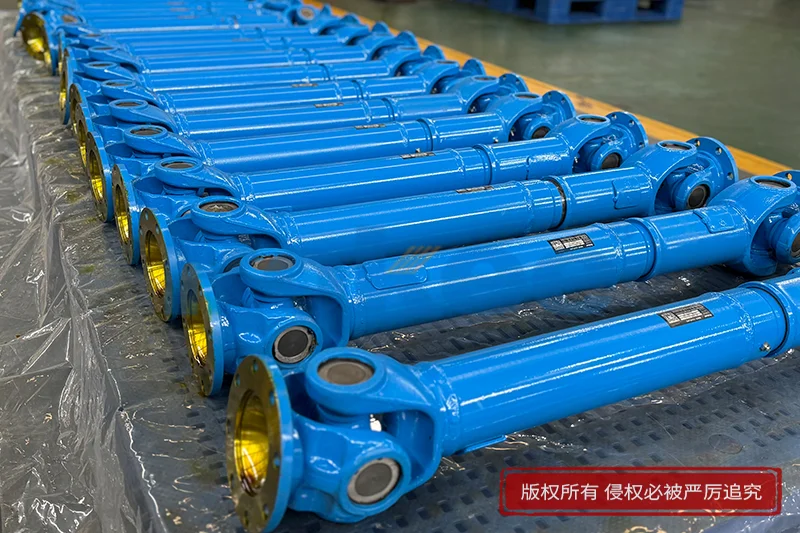
The inherent structural design of the cross universal shaft coupling lays the foundation for its superior transmission performance, featuring a compact, symmetric, and highly durable mechanical configuration. The entire transmission assembly relies on a precision-machined cross-shaped spindle, also known as a spider, as the core force-bearing and connecting component. Four mutually perpendicular shaft necks extend from the central cross structure, each fitted with high-precision needle roller bearings and sealed reasonably to form flexible rotational hinge points. These four sets of bearing structures are embedded into the fork-shaped joints at the input and output ends respectively, realizing the movable connection between the driving shaft and the driven shaft. Auxiliary structural parts such as lubrication channels and sealing components are integrated into the overall design, solving the core problems of friction wear and dust pollution during long-term operation. The rationality of this structural design lies in its spatial motion flexibility: the cross spindle can perform real-time spatial swing and angle adjustment with the rotation of the driving shaft, allowing the two fork joints to rotate relatively around orthogonal axes, thereby realizing continuous torque transmission under non-coaxial working conditions.
The working mechanism of the cross universal shaft coupling follows precise spatial kinematic laws, enabling efficient power transmission under various misalignment states. In standard operating environments where the driving shaft and driven shaft maintain strict coaxiality, the coupling operates in a synchronous rotating state with stable speed and uniform torque output, consistent with the transmission effect of conventional rigid couplings. The core value of the coupling is fully reflected in complex working conditions with angular deviation, axial displacement, or comprehensive misalignment between shafts. When an angular offset exists between the input and output shafts, the rotating driving fork joint drives the cross spindle to generate periodic spatial deflection. The four sets of needle roller bearings continuously rotate and adaptively adjust contact angles during operation, converting the eccentric rotational motion of the driving end into stable rotational output of the driven end. Although a single cross universal coupling will produce slight periodic speed fluctuation during angular transmission due to kinematic characteristics, this inherent defect can be effectively eliminated through paired installation of two couplings, achieving approximately constant angular velocity transmission. This adaptive motion adjustment capability allows the coupling to cope with installation errors, equipment vibration, and structural deformation during mechanical operation, ensuring uninterrupted power transmission.
The comprehensive performance advantages of cross universal shaft couplings make them irreplaceable in high-load and complex transmission scenarios. First and foremost, they possess outstanding misalignment compensation capability, stably adapting to angular misalignment within 5 to 45 degrees and a certain range of axial and radial displacement deviations. This greatly reduces the precision requirements for equipment shaft installation, lowers assembly costs, and tolerates minor structural displacements caused by equipment operation vibration, thermal expansion, and mechanical fatigue. Secondly, the coupling exhibits excellent high torque transmission performance. The integral cross spindle structure and high-strength bearing configuration enable uniform stress distribution during operation, effectively bearing large instantaneous impact loads and continuous heavy loads, making it suitable for heavy-duty mechanical transmission scenarios that rigid and elastic couplings cannot adapt to. In addition, the overall structure features high rigidity and good dynamic stability. The symmetric mechanical design avoids unbalanced centrifugal force during high-speed rotation, ensuring smooth operation with low vibration and low noise. Meanwhile, the standardized structural layout brings remarkable durability; with reasonable lubrication and sealing protection, the wearing parts maintain stable performance under long-cycle and high-intensity operation, extending the overall service life of mechanical equipment.
Diverse industrial scenarios have put forward differentiated application requirements for cross universal shaft couplings, promoting their wide penetration in multiple fields. In the automotive industry, this coupling is a key component of vehicle transmission systems, connecting gearboxes, drive axles, and power output structures. Vehicle operation is accompanied by frequent body jitter, chassis deformation, and angle changes during driving, and the coupling’s flexible compensation capability effectively adapts to these dynamic changes, ensuring stable power output from the engine to the wheels and improving driving smoothness and power response efficiency. In heavy engineering machinery such as excavators, cranes, and loaders, the working environment is harsh with frequent impact loads and complex equipment posture changes. The high torque resistance and strong impact resistance of cross universal shaft couplings ensure reliable power transmission for walking, lifting, and rotating mechanisms, avoiding transmission failure caused by load fluctuations.
In metallurgical, mining, and chemical industrial equipment, mechanical systems often operate continuously for long hours with high ambient temperature, dust pollution, and slight structural deformation of equipment supports. The excellent environmental adaptability and structural stability of cross universal shaft couplings enable them to maintain stable transmission performance in harsh working conditions, reducing equipment downtime caused by transmission component failure. Agricultural machinery such as tractors and harvesters usually works on uneven terrain, with continuous vibration and attitude changes during operation. The coupling’s misalignment compensation function can well adapt to the complex working terrain, ensuring efficient output of mechanical power and improving the operational reliability of agricultural equipment. Beyond traditional industrial fields, cross universal shaft couplings are also applied in high-precision fields such as aerospace auxiliary transmission systems and precision testing equipment. Through material upgrading and precision machining optimization, high-precision couplings can realize low-loss and high-stability transmission, meeting the stringent precision and reliability requirements of high-end equipment.
Long-term stable operation of cross universal shaft couplings relies on standardized daily maintenance and scientific fault prevention measures, as structural wear and lubrication failure are the main causes of performance degradation. In the working process, the relative friction between the cross spindle shaft neck and needle roller bearings is the main source of component wear. Regular lubrication maintenance through reserved lubrication channels can effectively reduce friction resistance, avoid dry wear of metal parts, and reduce mechanical loss and component fatigue damage. Sealing performance inspection is also crucial; damaged sealing structures will lead to external dust, impurities, and moisture entering the bearing gap, causing bearing corrosion, clamping stagnation, and increased wear, which will affect transmission smoothness and even lead to torque transmission interruption in severe cases.
In daily equipment operation, abnormal vibration, noise, or rotational speed jitter of the transmission system usually indicates potential faults of the coupling, such as excessive bearing wear, loose connecting parts, or abnormal angular deviation beyond the adaptive range. Timely inspection and adjustment can effectively avoid minor faults evolving into major equipment failures. In addition, regular detection of component deformation and stress fatigue is required for couplings that operate under high load and impact conditions for a long time. Timely replacement of aging and fatigue components can ensure the long-term stable and safe operation of the entire transmission system. Scientific maintenance not only extends the service life of cross universal shaft couplings but also reduces the overall operation and maintenance cost of mechanical equipment and improves production efficiency.
With the continuous progress of mechanical manufacturing technology and the upgrading of industrial equipment, cross universal shaft couplings are also evolving towards high precision, high strength, lightweight, and long life. Traditional couplings are mostly made of ordinary alloy steel, which can meet conventional industrial needs, but have limitations in high-temperature resistance, corrosion resistance, and fatigue resistance. In recent years, with the application of high-strength alloy materials, surface carburizing and quenching processes, and precision grinding technology, the structural strength, wear resistance, and environmental adaptability of couplings have been significantly improved, enabling them to adapt to more extreme working conditions such as high temperature, high humidity, and strong corrosion. At the same time, structural optimization design further improves the kinematic performance of couplings. Optimized bearing matching and spatial structure layout reduce speed fluctuation and transmission loss, realizing higher-precision and higher-efficiency power transmission.
In the context of modern industrial intelligent manufacturing, the performance of transmission components directly determines the operational efficiency and stability of mechanical equipment. As a classic and mature transmission component, the cross universal shaft coupling, with its unique structural advantages and reliable working performance, still has irreplaceable application value in numerous mechanical transmission scenarios. It not only solves the technical problem of power transmission between misaligned rotating shafts but also provides a stable guarantee for the efficient operation of various mechanical equipment. With the continuous development of industrial technology and the continuous expansion of application scenarios, cross universal shaft couplings will continue to complete technological iteration and performance upgrading, adapt to more diversified and high-standard industrial working conditions, and play a more important role in the development of modern mechanical transmission technology.
Tags: Telescopic Universal Joint , Universal Coupling Joint , Universal Coupling Shaft , Universal Couplings , Universal Joints , Universal Shafts , Universal Shaft Couplings , Universal Shaft Joint , Universal Drive Shafts , Flange Universal Joint Couplings , Industrial Universal Joint , Small Universal Joint Couplings , Universal Cross Joint Couplings , Universal Joint Shaft Coupling , Universal Joint Shaft Coupler , Universal Joint Shafts , pu sandwich panel machine , pu sandwich panel line
« Cross Universal Shaft Couplings » Update Date: 2026/7/16
Contact
If you require custom machined couplings, please contact Rokee via the contact information below for inquiries.
Email: https://www.gshmdpq.com
 WeChat
Industrial Couplings
You may also like
- Flexible Coupling Diaphragm Group
- SWC Transmission Shaft
- Flexible Block Gear Couplings
- Intermediate Shaft of Toothed Coupling
- Cross Joint Transmission Shaft
- WGP Brake Disc Gear Coupling
- Large drum gear coupling of national standard
- Ring Gear
- Industrial Curved-tooth Gear Coupling
- GIICLZ2 Drum Gear Coupling(Export)