Universal Couplings Supplier
As a core mechanical transmission component, universal couplings stand as an indispensable pillar in modern industrial machinery, automotive systems, aerospace equipment and various precision mechanical devices. Also widely known as universal joints or Cardan joints, these ingeniously engineered components solve the long-standing mechanical challenge of power transmission between misaligned rotating shafts, delivering stable torque output and continuous rotational motion even under complex spatial displacement conditions. Unlike rigid coupling solutions that demand extremely precise shaft alignment and fail to adapt to operational deviations, universal couplings feature flexible spatial movement capabilities, effectively compensating for angular, axial and radial misalignments generated during equipment installation, operation and mechanical deformation. This unique adaptive performance makes them a fundamental guarantee for the stable, efficient and long-term operation of diverse mechanical transmission systems, laying a solid foundation for the upgrading and iteration of global industrial manufacturing and transportation equipment.
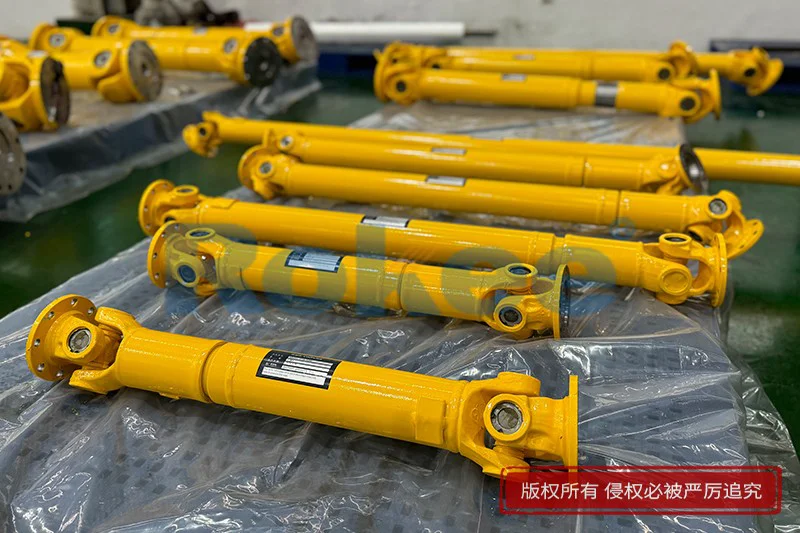
The inherent structural advantages and working mechanism of universal couplings determine their irreplaceable status in the mechanical transmission industry. At the core of the standard universal coupling design lies a sophisticated spatial hinge structure composed of cross trunnions, precision bearings and double fork yokes, a classic mechanical structure that follows the principle of spatial linkage motion. The two fork yokes are respectively fixed on the driving shaft and driven shaft, with the cross trunnion connecting the two yoke structures through high-precision bearing sets. This structural layout endows the coupling with multi-directional rotational freedom, enabling it to maintain synchronous rotation and stable torque transmission when the two connected shafts form a certain angular deviation. In actual operational scenarios, mechanical equipment inevitably produces shaft position changes due to installation errors, component wear, thermal expansion and contraction, or dynamic vibration during operation. Rigid transmission structures are prone to torque loss, component stress concentration, abnormal vibration and even structural damage under such conditions, while universal couplings can flexibly adapt to these variable working conditions, buffer mechanical vibration and reduce transmission friction loss, ensuring the continuity and stability of power transmission in complex operating environments.
The performance boundaries of universal couplings cover a wide range of industrial adaptation requirements, with mature structural designs enabling them to accommodate angular misalignment from 5 degrees up to 45 degrees. Practical industrial application experience shows that the optimal operating angle for most universal coupling specifications is maintained between 15 and 30 degrees, within which the components can achieve the best balance of transmission efficiency, service life and operational stability. Working beyond the optimal angle range will not cause functional failure in a short time, but will increase bearing and cross trunnion wear, reduce transmission accuracy and shorten the overall service cycle. In addition to angular compensation capabilities, high-quality universal couplings also possess excellent axial and radial displacement compensation performance, which can effectively offset small-scale shaft spacing changes and radial offset generated during equipment operation. This comprehensive multi-dimensional compensation ability enables universal couplings to adapt to diverse complex working conditions, ranging from low-speed and heavy-load industrial mechanical transmission to high-speed and high-precision power transmission of precision equipment, covering almost all scenarios that require flexible shaft connection and torque transmission.
Material selection and precision manufacturing processes are the core factors that determine the performance, durability and operational reliability of universal couplings. As key components bearing cyclic torque, impact load and frictional wear, universal couplings have extremely strict requirements on material mechanical properties. High-quality universal coupling products mostly adopt high-strength alloy steel and carbon steel materials with excellent toughness, fatigue resistance and wear resistance. These materials undergo standardized forging, heat treatment and surface strengthening processes to effectively improve the structural strength, torsional rigidity and high-temperature resistance of the components, avoiding structural fatigue failure, plastic deformation and premature wear under long-term variable load operation. The precision matching of internal bearing sets and cross trunnions is equally critical. Advanced finishing and precision grinding processes are adopted in production to control component tolerances within micron levels, ensuring smooth rotation, low friction and no jitter during high-speed operation. Meanwhile, standardized surface anti-corrosion and lubrication treatments are applied to the products, which can effectively resist the erosion of humid, dusty and corrosive industrial environments, reduce internal frictional resistance, and extend the continuous service life of the coupling in harsh working conditions.
The diverse structural forms of universal couplings enable them to meet the differentiated needs of various industrial scenarios, realizing targeted applications in multiple fields. Single universal couplings feature a simple structure and flexible installation, suitable for light-load and medium-speed transmission scenarios such as general mechanical equipment, small processing machinery and auxiliary transmission systems. Double universal couplings, composed of two single joints and intermediate connecting shafts, can effectively eliminate the speed fluctuation problem of single universal joints under large-angle transmission, achieving constant-speed torque transmission, and are widely used in automotive transmission systems, engineering machinery and agricultural equipment. Telescopic universal couplings integrate axial telescopic functions on the basis of the universal joint structure, which can adapt to axial distance changes between shafts during equipment operation, and are commonly used in mobile mechanical equipment and automated production lines with frequent position changes. Heavy-duty welded universal couplings adopt integral welding and thickened structural design, with super high torsional resistance and load-bearing capacity, adapting to heavy-load and low-speed working conditions of metallurgical machinery, mining equipment and large industrial transmission devices. This rich product spectrum enables universal couplings to cover light, medium and heavy load scenarios, realizing full-scene penetration in the industrial transmission field.
The automotive and transportation industry is one of the largest application scenarios for universal couplings, where their flexible transmission characteristics guarantee the normal operation of vehicle power systems. In passenger vehicles, commercial vehicles and engineering vehicles, universal couplings are core components of chassis transmission systems, responsible for transmitting engine power to drive axles. During vehicle driving, the suspension system will continuously produce jitter and displacement with road conditions, causing real-time changes in the relative position and angle between the transmission shaft and drive axle. Universal couplings can flexibly adapt to these dynamic changes, maintaining stable power output, avoiding power interruption or transmission jitter, and ensuring driving smoothness and operational safety. In addition, universal couplings are also widely used in special vehicles, agricultural machinery and construction machinery. Complex working environments such as farmland, construction sites and mines put forward higher requirements for the shock resistance and environmental adaptability of transmission components, and the excellent compensation performance and structural durability of universal couplings can fully meet the harsh operational needs of these mobile mechanical equipment.
In the field of industrial manufacturing and precision machinery, universal couplings play a vital role in improving equipment operational accuracy and production stability. Automated production lines, CNC processing equipment, packaging machinery and textile machinery all require high-precision and low-jitter power transmission to ensure product processing consistency and production efficiency. High-precision universal couplings can eliminate transmission errors caused by shaft misalignment, ensure synchronous operation of multi-axis linkage equipment, and improve the overall operational accuracy of mechanical systems. In heavy industrial fields such as metallurgy, mining and port machinery, equipment operates under long-term heavy load and strong vibration conditions, and traditional rigid coupling components are prone to frequent failure and short service life. Heavy-duty universal couplings rely on high-strength structural design and excellent shock absorption performance, which can bear cyclic impact loads, reduce equipment vibration and noise, lower the failure rate of transmission systems, and reduce enterprise equipment maintenance costs and downtime losses. At the same time, in aerospace, intelligent robots, medical equipment and other high-precision fields, miniaturized and high-precision universal couplings are applied, featuring compact structure, light weight and high transmission efficiency, meeting the ultra-high precision and reliability requirements of sophisticated equipment.
As global industrial manufacturing continues to upgrade and mechanical equipment develops toward high precision, high efficiency and high durability, the market demand for high-performance universal couplings is showing a steady growth trend. Modern industrial equipment has increasingly stringent requirements for transmission component stability, energy conservation and service life. Traditional coupling products with single performance and poor adaptability can no longer meet the iterative needs of advanced manufacturing. High-quality universal couplings, with their multi-dimensional misalignment compensation, efficient transmission performance and strong environmental adaptability, have become the preferred solution for modern mechanical transmission systems. Meanwhile, with the rapid development of new energy equipment, intelligent manufacturing equipment and special engineering machinery, the application scenarios of universal couplings are constantly expanding, putting forward higher requirements for product customization, precision and structural diversification. Industrial development is driving universal coupling products to evolve toward high precision, high strength, low energy consumption and customized differentiation.
In the global industrial supply chain, professional universal coupling suppliers undertake the important responsibility of product research and development, precision manufacturing and reliable supply, and their comprehensive strength directly affects the operational quality of downstream industrial equipment. Excellent suppliers always take product quality and application performance as the core, adhering to standardized production systems and strict quality control mechanisms. From raw material screening and performance testing to precision processing, heat treatment and finished product inspection, every production link implements rigorous quality supervision to ensure that each batch of products meets industrial application standards and customer scenario requirements. In view of the differentiated needs of different industries and equipment, professional suppliers also have strong customized development capabilities, which can adjust product structure, material specifications and precision parameters according to the special working conditions of high temperature, low temperature, strong corrosion and ultra-heavy load, providing targeted transmission component solutions for diverse industrial scenarios.
Supply chain stability and technical service capability are also key competitive advantages of outstanding universal coupling suppliers. In the global manufacturing system, downstream enterprises have extremely high requirements for product delivery timeliness and after-sales technical support. Reliable suppliers establish standardized production inventory systems and efficient supply chain scheduling mechanisms to ensure stable product supply and rapid order response, effectively solving the production continuity problems of downstream enterprises. At the same time, professional technical teams can provide customers with whole-process support including model selection guidance, installation technical guidance, operational fault analysis and equipment maintenance suggestions. Combining on-site working condition characteristics and equipment operational parameters, they help customers select the most matching universal coupling products, avoid equipment failure risks caused by improper model selection or installation, and maximize the operational efficiency and service life of mechanical transmission systems.
Looking ahead, with the continuous progress of material technology, precision manufacturing technology and intelligent detection technology, the performance of universal couplings will be further optimized and upgraded. The application of new high-strength and wear-resistant materials will further improve the load-bearing capacity and fatigue resistance of products, adapting to more extreme industrial working conditions. The popularization of intelligent precision processing equipment will realize higher-precision component manufacturing, further improving transmission efficiency and operational stability. Meanwhile, with the deep integration of industrial intelligence and mechanical equipment, intelligent universal couplings with real-time monitoring of operational status, wear degree and load changes will become an important development trend, helping downstream enterprises realize intelligent equipment operation and predictive maintenance. As a basic core component of the mechanical industry, universal couplings will always accompany the development of global industrial manufacturing, continuously exerting irreplaceable core value in equipment power transmission and mechanical system stability guarantee.
Tags: Telescopic Universal Joint , Universal Coupling Joint , Universal Coupling Shaft , Universal Couplings , Universal Joints , Universal Shafts , Universal Shaft Couplings , Universal Shaft Joint , Universal Drive Shafts , Flange Universal Joint Couplings , Industrial Universal Joint , Small Universal Joint Couplings , Universal Cross Joint Couplings , Universal Joint Shaft Coupling , Universal Joint Shaft Coupler , Universal Joint Shafts , sandwich panel machine , pu sandwich panel line
« Universal Couplings Supplier » Update Date: 2026/7/16
Contact
If you require custom machined couplings, please contact Rokee via the contact information below for inquiries.
Email: https://www.gshmdpq.com
 WeChat
Industrial Couplings
You may also like
- Universal Couplings Size Chart
- Types of Spline Gear Couplings
- Universal Cross Joint Coupling Size Chart
- Universal Couplings Catalogue
- Cross Cardan Shafts 3D Model
- Tooth Couplings Manufacturing Enterprise
- Types of Barrel Gear Couplings
- Types of Pin Couplings
- Diaphragm Coupling Types
- Plate Couplings Engineering Drawing